Install Vonage Dialogue Provider
Note
An Enterprise license or higher is required to access these features.
Note
An Dialogue Cloud WebAgent for Omnichannel license is required.
Note
This feature requires an additional license from an AnywhereNow partner.
Prerequisites
-
Vonage Account with WhatsApp or Message channel
Provider & number limits per A Unified Contact Center, or UCC, is a queue of interactions (voice, email, IM, etc.) that are handled by Agents. Each UCC has its own settings, IVR menus and Agents. Agents can belong to one or several UCCs and can have multiple skills (competencies). A UCC can be visualized as a contact center “micro service”. Customers can utilize one UCC (e.g. a global helpdesk), a few UCC’s (e.g. for each department or regional office) or hundreds of UCC’s (e.g. for each bed at a hospital). They are interconnected and can all be managed from one central location.
You can’t mix messaging providers in a single UCC.
A UCC may use only one provider (CM or Vonage) for phone-based channels.
Read more
Allowed
-
WhatsApp + SMS from the same provider (CM or Vonage) in one UCC.
-
Email (EDP) and WebChat (WCDP) in that same UCC alongside your chosen provider.
Not allowed
-
WhatsApp and SMS from different providers in one UCC (e.g., WhatsApp via CM and SMS via Vonage).
-
Multiple WhatsApp numbers in one UCC — use a separate UCC per WhatsApp number.
-
Multiple SMS numbers in one UCC — use a separate UCC per SMS number.
Examples
-
✅ One UCC with CM: WhatsApp (1 number) + SMS (1 number) + Email (EDP) + WebChat (WCDP).
-
❌ One UCC with WhatsApp via CM + SMS via Vonage → split into two UCCs.
-
❌ One UCC with two WhatsApp numbers → create one UCC per WhatsApp number.
-
❌ One UCC with three SMS numbers → create one UCC per SMS number.
-
Requirements
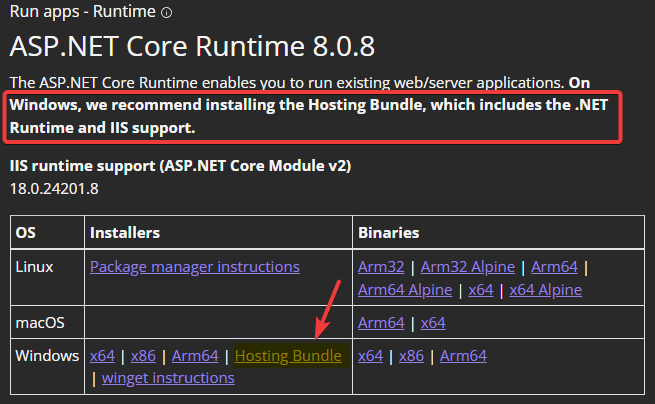
- Install ASP.NET Core 6.0.8 (or a later 6.0 series) Hosting A bundle is a fixed combination of our software platform elements of very specific versions. These are designed and tested to optimally work together to assure their intended function and interoperability. (if you have not already done this)
%20hostingbundle.png)
Bundle 2024.02 and later: Microsoft ASP.NET Core 8.0.0 (or a later 8.0 series) Hosting Bundle installed (may already be installed).
Installation
Deploy package
-
Unzip the VonageDialogue Provider package
-
Edit the properties.ps1
-
Domain = Domain of the install account
-
UserName = Username of the install account
-
-
Run install.ps1 in PowerShell as administrator
Add Plugins Settings
-
Open the UCC Config page on SharePoint
-
Open the Plugin Settings list
-
Add the following settings:
Note
AuthorizationHeaderValue is provided by Vonage.
Setting Value Description Setting: Enabled
Scope: VonageDialogueProvider
TRUE
Indicates whether the dialogue provider is actively used.
Setting: Keyword
Scope: VonageDialogueProvider
VonageDialogueProvider
Note:
This name is not the name displayed on the WhatsApp for Business Number, which is configured via the Meta Business Manager. This name is only used to be stored within the AnywhereNow Dialogue Manager database.
Warning:
The Name can only have the following characters:
- Lower case: a-z
- Upper case: A-Z
- Numbers: 0-9
Used a ReceiverName for Dialogue Manager database.
Setting: PollingIntervalInSeconds
Scope: VonageDialogueProvider
1
Time between each poll to send outgoing messages.
Setting: BaseAddress
Scope: VonageDialogueProvider
https://example.com
The base address of the Vonage Message API used to connect Vonage Message API.
Setting: AuthorizationHeaderValue
Scope: VonageDialogueProvider
XXXXXXXX-XXXX-XXXX-XXXX-XXXXXXXXXXXX
The unique identifier used to authorize with the Messaging API
-
For Basic Authentication use: "Basic {Base64 APIKey:APISecret}"
-
For Bearer Authentication use: "Bearer {JWT Token}"
Setting: Sms
Scope: VonageDialogueProvider
+XXXXXXXXXX
Phonenumber for SMS.
Setting: WaitForStatusReport
Scope: VonageDialogueProvider
FALSE
Indicates whether system should wait for status reports on outgoing messages; status reports indicate whether sending an outgoing message is successful or not.
Setting: WhatsApp
Scope: VonageDialogueProvider
+XXXXXXXXXX
Phonenumber for WhatsApp.
Add Endpoint
-
Open the UCC Config page on SharePoint
-
Open the Plugin Settings list
-
Add DialogueManager settings endpoint for ListsPlugin > ListsEndpoints
Note
Add to the existing item and separate with "Enter".
Setting Value Description Setting: ListsEndpoints
Scope: ListsPlugin
http://FDQN stands for Fully Qualified Domain Name and specifies the exact location in the tree hierarchy of the Domain Name System (DNS). An example for [hostname].[domain].[top level domain] is [www].[microsoft].[com]/webagentservice/api/v1/settings
http://FQDN/DialogueManager/api/v1/settings
https://FQDN/VonageDialogueProvider/api/v1/settings
Warning
It is important to configure this setting to one main regional URL when using multiple services in the same region. If this is not done, you may experience unexpected behavior.
Warning
Make sure to leave the fqdn to this service configured as a ".local" URL, especially when using multiple UCC services in the same region. If this is not done, the UCC cannot reach the right webserver internally leading to undesired or non-functional WebAgent behavior.
Note
URL needs to be accessible from the UCC Service to the Vonage Dialogue Provider.
Used by the ListsPlugin to push the settings from the settings from SharePoint to the URL of the service.
-
For all the available settings to finetune the Vonage Dialogue Provider, see: WhatsApp and SMS Dialogue Provider Plugin Settings Overview
Create and assign Skills
-
Create regular skill, see: Standard Skill
-
Add Agents, see: Agents
-
Assign Skills to Agents, see: Skills per Agent
Add Plugins Attributes
-
Open the UCC Config page on SharePoint
-
Open the Plugin Attributes list
-
Add the following attributes:
Display Name System Name Show on Extension Window Show on A toast is a pop-up instant message or audio call notification the user receives on his desktop. Order Open Automatically Category Subject
Subject
No
No
1
No
Contact
SenderDisplayName
SenderName
No
No
2
No
Contact
SenderUri
SenderUri
No
No
3
No
Contact
Body
Content
No
No
4
No
Contact
Add Plugin Flow Settings
-
Open the UCC Config page on SharePoint
-
Open the Plugin Flow Settings list
-
Below an example on how to setup the Plugin Flow Settings:
Attribute Operator Value Order Action Skill Channel
Equals
WhatsApp
1.00
Skill
WhatsApp
Channel
Not equals
WhatsApp
2.00
Skill
WhatsApp
More information about Plugin Flow Settings, Learn More
For more example, Learn More
Configure Webhook in WhatsApp messaging partner
-
Login into the Vonage Dashboard
-
Navigate to Your applications
-
Select your application
-
Enable Messages
Note
Currently only the v0.1 Messaging API is supported.
-
Add the following Urls
-
Inbound URL: https://FQDN/VonageDialogueProvider/api/v1/response
-
Status URL: https://FQDN/VonageDialogueProvider/api/v1/status
Note
The URL needs to be publicly available.
-
Restart UCC and validate
-
Login to the AnywhereNow Application Server
-
Start Services
-
Restart "Unified Contact Center"
-
See the logs if Dialogue Manager is successfully loaded
UCC Logs
C:\ProgramData\Anywhere365\Core\Service\UnifiedContactCenterService\logs
2019-04-18 15:39:30,716 [5] Wsp.Anywhere365.Ucc.Lists.ListsPlugin.ListsRequest DEBUG - ListsPlugin SendRequest Endpoint: http://FQDN/VonageDialogueProvider/api/v1/settings - body: {"Version":"1.1.7"...}Vonage Dialogue Provider log:
2019-04-18 16:13:32.7046 DEBUG SettingsManager - Added settings for UCC ucc__whatsapp
2019-04-18 16:13:32.7075 TRACE ProviderManager - TryAddUcc ucc__whatsapp